Thursday, 17 July 2008

Converge - Jane Doe

Jane Doe is probably my favourite record ever. If not, it certainly comes close. I wouldn't normally post something like this because I assume that the two or three people that actually bother to read this would be familiar with this album. But then I had this staggering realisation that, you know, there are people who haven't heard this album, or people who, worse, don't "get" it. It saddens me that people are missing out on something so incredible. Well, here's your chance to repent.

Jane Doe is an album and needs to be heard as such. I need to stress the importance of this. It is a cohesive experience, the expression of and expansion upon a single emotion to overwhelming effect. It is highly unlikely that you are going to "get" Jane Doe just by listening to Concubine or The Broken Vow as standalone songs. Every moment in this album contributes to the next, hurtling madly towards those last three minutes of the title track. The album is a perfect example of the powerfully cathartic nature of hardcore: a comprehensive outpour of an emotion, like wringing water from a sponge until nothing is left.

This album is a rollercoaster of emotion recorded in the aftermath of a heartbreak that left Jacob Bannon feeling low and damaged. It shows, because all the associated emotions are there: from the shock, denial and desperation following loss to the ensuing feelings of spite and hatred, the nadir of defeat, depression and self-loathing, the cold grip of loneliness and, tucked away in a corner somewhere but nevertheless present, hope.

The lyrics, for one, are stunning. They don't necessarily match up to the music in a linear fashion - rather, Jacob Bannon writes them like poetry, then uses them as inspiration for the songs, lifting lines and placing them in appropriate places for maximum impact. Take Concubine's desperate cries of "Dear, I'll stay gold just to keep these pasts at bay", Bitter and then Some's vitriolic chant "Death to cowards, traitors and empty words" or the beautiful penultimate part of the title track "Lost in you like Saturday nights/Searching the streets with bedroom eyes/Just dying to be saved" and you have just some examples of Bannon's skilled and heartfelt lyricism. There is a particularly haunting passage in Hell to Pay, as another example, that really sums up the kind of engulfing depression that takes its hold post-heartbreak:

"That night, I think he cried himself to sleep
Just maybe, he felt more than we could ever know
And I think he pulled that trigger to empty that memory
I think he cut the weight to end the floods of you
Let him soar, let him ride as budding gravestones do
Just sleep, girl, just dream well"


Jane Doe, of course, isn't anything without the music. And what sublime music it is: from the discordant opening measures of Concubine the listener is thrown into some of the most intense, chaotic music ever written. The mood varies; from raucous and chaotic in Homewrecker and Bitter and then Some to pensive in Hell to Pay, with its enormous bassline, and epic in Phoenix in Flight. There is a sense of uncontrollable and climactic chaos throughout the album, untamed amounts of passion that are hard to find in any other album. One particular highlight is The Broken Vow, an anthem that finishes on the rousing and desperate chant "I'll take my love to the grave". There are some interesting but also successful experiments on the album such as the eerie "Phoenix in Flames", a short slice of chaos that sees the band stripping themselves down to a core of drums and vocals. Thaw is also particularly climactic with its jarring riff and its crushing closing chord sequence. This still serves as a mere warmup for the album's title track. There's a rather clichéd phrase that goes "it's always darkest before the dawn" - to me, much of the song Jane Doe represents that state of rock bottom. It charts that feeling of hopelessness, of being completely lost. There's a moment about 45 seconds into the dirge where Bannon suddenly switches gears into a voice that's so different to his usual scream that it's ethereal, singing "I want out" like a desperate cry for help. It's one of the most incredibly affecting parts of the album. The song repeats itself in a cyclic pattern, spiraling more and more into that pit of despair until something happens - something changes. There's a break in the music, and a wonderful sense of space and release. There is one final chorus, like a sigh put to music, before it kicks in. A searing crescendo that has so much intensity that it could easily rival anything that Godspeed You! Black Emperor have ever written, rising out of the gloom like a phoenix in flight, the culmination of so many things gone wrong but perhaps a sign of determination to move past those events, a sign of hope. And that concludes not only the best album closer these ears have ever heard, but perhaps the best album too. Jane Doe is an album of limitless passion and honesty, an intensely personal statement that stands as an incredible work of art. Whether screaming, chaotic hardcore is your thing or not, take a chance on this album - spend some time with it, get to know it well, and perhaps, soon enough, you too will feel its rewards. If you haven't felt anything by the time that culminating crescendo fades out, you can't be human.

Those nights we had and the trust we lost
The sleep that fled me and the heart I lost
It all reminds me
Just how callous and heartless the true cowards are
And I write this for the loveless
And for the risks we take
I'll take my love to the grave
As tired and worn it is
I'll take my love to the grave
-Converge; The Broken Vow

Converge - The Poacher Diaries

In all my excitement about seeing Converge tomorrow, I decided to do a bit of a Converge special today. And so, to get things going, I present you with their 1999 split with Agoraphobic Nosebleed, The Poacher Diaries. (Agoraphobic Nosebleed's side isn't worth bothering with. Trust me on this one. Regard it as a Converge EP).


This split has some of Converge's most punishing cuts to date. Opening with Locust Reign (a short but sweet live favourite) and This is Mine, the four-piece waste no time in announcing their presence with two short, sharp blows to the eardrums. From there on it gets a bit more pensive with the almost psychedelic They Stretch For Miles (featuring a very well-placed Fear and Loathing in Las Vegas sample) before resuming the skull-crushing riffathon in My Great Devastator (the album's best track) and The Human Shield. Minnesota concludes the album in epic fashion, featuring some great slide guitar and clean vocals (yes, your ears aren't deceiving you, that's Jacob Bannon doing some actual singing). The brutality and relative brevity of Converge's side of this split, alongside the overall strength of the songwriting, makes this one a keeper.

Sunday, 29 June 2008

Grouper - Dragging a Dead Deer Up a Hill

Grouper is the Oregon-based Liz Harris. Noone more, noone less. Over the last few years she has been quietly making a name for herself through her ethereal and haunting songs, shrouded in a thick fog of vocal loops and guitar ambience, akin to perhaps My Bloody Valentine if they decided to ditch their "louder is better" approach and go acoustic. It seems that these days she's decidedly walking out of that fog: here on her latest effort, we have twelve folk songs that shine with a new-found clarity. Liz's stellar vocal harmonies float effortlessly above her gently strummed, reverb-drenched guitars to create something utterly mesmerising. Don't be fooled by the creepy cover art and equally creepy title, there's something about these songs that's beautifully calm and delicate - they lull you into a sense of total serenity where nothing matters but the haunting melodies that drift around in your subconscious. These are folk songs that are as subtle as they are powerful, taking a gentle but hypnotic approach that works its magic slowly but eventually becomes very endearing. "Dragging a Dead Deer Up a Hill" is the light at the end of the tunnel in musical form.

Buy

(link behind cover art)

Friday, 27 June 2008

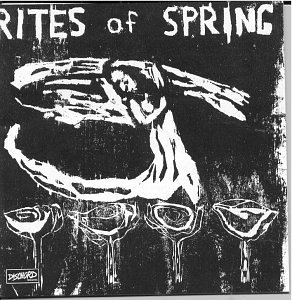
Rites of Spring - End on End


Before the formation of Fugazi, there was a band that was every bit as good.

Depending on whether or not you've ever done a bit of research into the history of a certain infamous three-letter term, you may or may not already be familiar with Rites of Spring. Yes, they are often credited as being the originators of emo - or, that is to say, emotional hardcore. Obviously the real value of this term is highly disputable - as Picciotto said himself, "honestly, I just thought that all the bands I played in were punk rock bands. The reason I think it's so stupid is that - what, like the Bad Brains weren't emotional? What - they were robots or something? It just doesn't make any sense to me." As such, it makes more sense to think of Rites of Spring as a hardcore punk band for the purpose of this post, as it will also aid in understanding why the band were so important.

You see, context is everything if one wishes to properly appreciate Rites of Spring. Imagine this: the year is 1985. The DC hardcore scene is stagnating. Its giants, the likes of Bad Brains, Minor Threat and Black Flag, are showing signs of slowing down. Cracks were beginning to show in the movement: Hüsker Dü and their ilk were already taking steps to destroy hardcore as most people knew it, integrating more of a pop sensibility and elements of other styles into the otherwise straightforward, aggressive punk that had been established as the trademark DC sound. Suddenly, out of nowhere came an album on the legendary Dischord Records that used the hardcore blueprint, but introduced a new sense of pacing and melody that had barely been seen in the genre before. Not only this, but Picciotto's lyrics forsook the usual outwardly directed anger of most DC hardcore, instead favouring subtlety, depth and introspection. This, combined with his desperately passionate delivery, resulted in music that was unusually personal and emotional. It is interesting to note the staggering difference in lyrical depth between Rites of Spring and other DC hardcore bands - for the sake of contrast, here is a sample from perhaps the quintessential DC hardcore band, Minor Threat:

I don't want to hear it
All you do is talk about you
I don't want to hear it
'Cause I know that none of it's true
I don't want to hear it
Sick and tired of all your lies
I don't want to hear it
When are you gonna realize...
That I don't want to hear it
Know you're full of shit
-Minor Threat; I Don't Want to Hear It

Note that the lyrics are to the point and simple, full of outwardly directed anger. Compare this to the following sample from Rites of Spring's 'All There Is' and the difference is positively startling:

It's more than love
And it's less than love
It's what I give to you.
All there is is the knowing that this never had to end.
All there is to know.
If I could take, heart in hand, what I'd give to you.
All there is is in the knowing that this never has to end.
All there is to know.
-Rites of Spring; All There Is

The subject matter here is much more abstract and vague; far more personal and emotional than the former sample, dealing with deeper thoughts and ideas, using much more subtlety and leaving parts to speculation. Picciotto also had a notable sense of wit, providing a dry sense of humour in For Want Of''s declaration of "I woke up this morning with a piece of past caught in my throat... and then I choked" 0r Persistent Vision's "I was the champion of forgive-forget, but I haven't found a way to forgive you yet". Rites of Spring opened people up to the idea that hardcore could cover a greater spectrum of emotion than simply anger.

Picciotto's voice is awe-inspiring here, too. His unhinged delivery in Rites of Spring makes his contributions in Fugazi sound positively tame - a passionate, gravelly rasp that breaks into a desperate yelp at emotional climaxes. The band's songwriting made use of a pop sensibility that gives them a sense of immediacy that separated them from less accessible early emo bands such as Moss Icon's labyrinthine spoken word passages.

And the band's importance doesn't stop at the invention of emo - there is even a precocious post-hardcore gem in the form of album highlight 'Drink Deep'. The song sounds startlingly similar to newer bands such as mewithoutYou (who wouldn't come about for another 15 years) and uses the same kind of groove that would be later expanded on fully in Fugazi. Simply put, Rites of Spring were not only an incredibly influential and important band, but a wildly emotional and enjoyable one that is absolutely worth devoting some time to.
Download the band's compiled discography 'End on End' here.

Saturday, 21 June 2008

Mix one: Nostalgia

Instead of doing the usual album-review entry, I felt like compiling a mix around a theme for this one. Lately I've found myself coincidentally listening to a lot of music that has a cutting sense of nostalgia to it. I'm not talking about songs that are nostalgic in that they remind you of a certain era: there's no mid-nineties europop here, no eighties cheese. Here I present you with twelve songs that sigh themselves: be it with over fond memories that never lasted, missed opportunities, opportunities that you never even got, friendship, love, or perhaps something even more abstract. In all honesty, it's not a good feeling at all, but it's a feeling that one tends to want to wallow in. In some way or another I have a strong emotional connection with each of these songs, and I strongly recommend that you investigate the output of all the bands featured here.

1. Mahumodo - April's
2. Trophy Scars - Assistant. Assistants
3. New Found Glory - Coming Home
4. Minus The Bear - The Pig War
5. American Football - Never Meant
6. Joanna Newsom - Sawdust & Diamonds
7. Gregor Samsa - Young & Old
8. Sun Kil Moon - Moorestown
9. Hopesfall - The End of an Era
10. Modern Life is War - I'm Not Ready
11. Thrice - Red Sky
12. Neil Young - Ambulance Blues


Download

Monday, 16 June 2008

Rinoa/Crydebris

So... mounting coursework, exams and general stress overload put a stopper on this blog over the last few months, so apologies for the lack of recent updates to the grand total of zero people who read this. Now summer has well and truly kicked in, however, I intend to do a bit of a posting marathon, so fasten your seatbelts.

So to kick things into gear again, I bought Rinoa's debut EP today. This four-piece comprises ex-members of the incredible Crydebris and the similarly brilliant purveyors of pg. 99-esque chaos Chariots. Sonically, they play emotionally intense hardcore laced with post-rock, very similar to Envy and labelmates Devil Sold His Soul in many respects. From the moment the introductory buildup of 'Between the Pillars' peaks, the music remains wonderfully climactic for the duration of the EP, only letting up on the intensity front for the dense ambient segue 'In a Single Day and Night of Misfortune' which serves as a way of lulling the listener into a false sense of security right before the monstrously riff-heavy assault of closer 'Atlantis' comes to leave the listener mouth agape. The four tracks are shrouded in Mono-esque atmospherics: soaring tremolo guitars and swirling ambience that adds an impressive (if perhaps a little "tried and tested") sense of expanse and majesty. Also particularly endearing is the permeating sense of pessimistic desperation - and anyone who has heard and loved Devil Sold His Soul's latest opus A Fragile Hope will know where I'm coming from - that last mustering up of hope, the desperate clinging on to that light at the end of the tunnel. As such, the repetition of the line "Watch me wade through water/I'm not waving/I am drowning" at the swelling conclusion of 'Atlantis' is the musical equivalent of a stake hammered right into the heart.


This brings me on to Rinoa's now-disbanded predecessor, Crydebris. Crydebris were special. They were one of those depressingly short-lived bands that released one incredible EP that reminded you of everything you loved about your country's underground music scene, then split up just when they appeared to be going somewhere. Sounds familiar, doesn't it? The Severing spliced the dissonant time signature-shifting chaos of Botch and Eden Maine with the spaced-out beauty of the likes of Mahumodo and No Wings To Speak Of-era Hopesfall, resulting in a sound that, at the time, felt like a refreshingly unique punch to the gut. Particular standout moments include the incredible explosion after the ambient lull in the middle of the title track, or the gang vocal-laden finale of 'Mononoke-Picture'. I was lucky to get my hands on a CD-R copy of this EP while the band were still together but, as the EP is no longer in circulation and available for download on the band's myspace anyway, I figured that it would be a safe bet uploading the EP for your listening pleasure.

I've been told
that hate will break your heart in two
and change the face that I once knew

So try just once to see life unclouded by hate.
- Mononoke-Picture; Crydebris


Download the track 'Atlantis' from Rinoa's self-titled debut here.
Download Crydebris' EP 'The Severing' here.

Sunday, 23 March 2008

Set Your Goals - interviewed

This article is due to appear in a future issue of the University of Nottingham's official music magazine The Mic. Many thanks are due to Natalie Passingham for helping hugely with the interview.


“I’ve been really frustrated the past couple of days. I feel everything’s changing musically. It’s sort of pushed onto us. People keep coming to us asking ‘what do you think of working with this producer/this songwriter?’ No one’s thinking for themselves anymore, everything’s being so mass produced.” Jordan Brown, one of Set Your Goals’ two vocalists, is pouring out his laments on the music industry in the dingy backstage area of Rock City. “At the same time, as much as that scene’s thriving and is dominant in the mainstream, there is always such a strong underground scene. I feel like it keeps me in a constant reality check, I really want to be such a part of that, it’s so much more real.” The band’s debut album Mutiny! is riddled with lyrical references to this strong independent ethic that they adhere to. “It’s important for bands to know they don’t need anyone, and that’s what the song ‘Mutiny’ is about - it’s about us taking over and doing it for ourselves. You need to be self-sufficient. Like the song says, people are telling you that you need to be their friend to get anywhere, which is not true.”

“There’s so many good bands out there” interjects Matt Wilson, vocalist number two. “If there’s one thing I’ve learnt from punk rock it’s that you don’t need that whole music industry, there are so many elements that don’t belong there. It’s not necessary - with the way things are now, bands releasing their CDs for free, anyone can get exposure. You can put it up on MySpace and if people react positively, you can press your own CDs.”

“It’s also true on a band-by-band basis. This tour is a perfect example of how punk you can be in the mainstream,” exclaims Jordan with more than a hint of excitement – “they [‘they’ being tour-mates Gallows] emailed all of us on this tour asking if we wanted to be on it. Obviously agents were involved in booking shows, but it wasn’t a case of ‘is this band going to help?’ It was more ‘these bands rule, these are bands we want people to know about’ and I think it’s important to have these bands in the mainstream that will bring others in.” “None of these bands give a shit about what people think of them”, explains Matt, “and Gallows are just interested in helping people out who they’re friends with that and that’s so awesome, all the bands deserve so much respect.”

Indeed, they’re no strangers themselves to the punk-rock touring schedule. Last year, they slogged it out on an enormous European tour – “7 and a half weeks with one off date” states Jordan, a figure that exhausts us just thinking about it. “We’ve learned our lesson as far as booking extensive tours go, you should take an off date every 3, 4 days. Especially to have time to see the locations you’re at.” Matt looks on the bright side, though – “It was amazing being able to go to places like Portugal, getting to experience their culture. I think it’s one of the best things of being in a touring band, getting to travel so much.” “I think it’s good to play in places outside of major cities, too” states Jordan. “Because obviously, France is not just Paris, not everyone can travel to Paris”.

Some major excitement has been coming their way as of late. On top of a support slot with Paramore and a coveted main stage appearance at Give It A Name this year, they have been approached by Vinnie Caruana to be his backing band playing songs by The Movielife at Bamboozle this year. Matt clarifies all: “We’d become friends with him through I am the Avalanche. Jordan met Vinnie back when he was in The Movielife, and we’ve been Movielife fans for a long time so it was an honour when he asked, it’s amazing.” “This is him giving closure to the Movielife so he can continue with I am the Avalanche and give back to the Movielife fans” beams Jordan, slightly bowled over by the whole thing. “We were thrilled when he asked. It was like ‘You didn’t even have to ask, you should have just booked it and told us ‘by the way’’…’’

Given the love they have for all things DIY and independent, we knew that SYG would have some bands that they would want give mention to. “I’ve been listening to a lot of A Wilhelm Scream recently, I think they’re awesome. I always try and plug The Swellers from Michigan, I think they’re doing something so amazing” says Jordan, eyes lighting up. “They’re really committed to touring and have a really good ethic. Even if you just go to our MySpace, we’re always switching up our MySpace friends so people can know who we think they should know about.”

So what is punk’s current situation in the midst of all this mainstream tomfoolery? Matt is confident about its relevance - “As long as the mainstream gets worse, there will be more revolt against it.” And as long as bands like Set Your Goals are around to affirm this, we couldn’t agree more.